All templates

Deploy phpMyAdmin on your own server.

phpMyAdmin logo

phpMyAdmin is a free software tool designed to manage MySQL over the web. This powerful tool supports a broad spectrum of operations on MySQL and MariaDB. It allows you to perform frequently used operations such as managing databases, tables, columns, relations, indexes, users, permissions, and more through its user-friendly interface.…

Your infrastructureAutomatic HTTPSNo lock-in

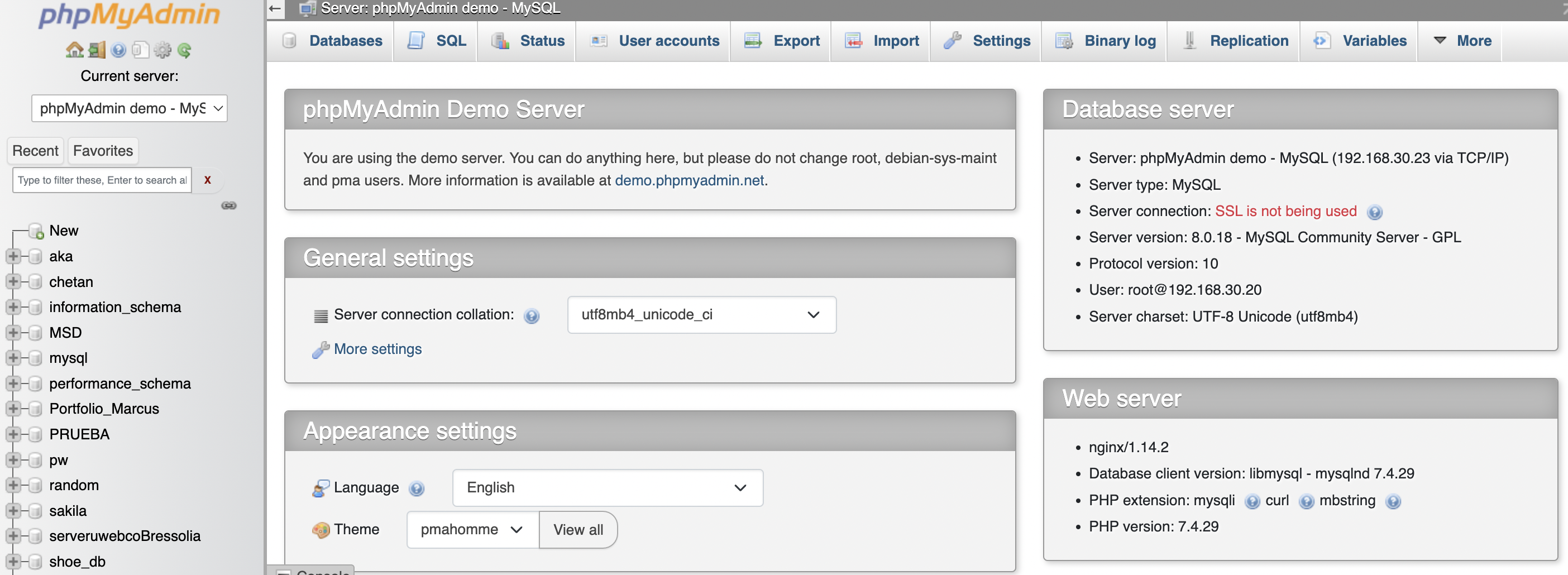
Screenshots

A closer look at phpMyAdmin.

phpMyAdmin screenshot 1

Setup time

A few minutes

Deployment

Your own server

Services

1 connected service

Why phpMyAdmin

Everything you need, running where you choose.

Get the full phpMyAdmin experience with Easypanel handling the repetitive infrastructure work around it.

Wide Range of MySQL Operations
phpMyAdmin supports a wide range of operations on MySQL and MariaDB. You can browse and drop databases, tables, views, fields, and indexes; create, copy, drop, rename, and alter databases, tables, fields, and indexes; manage MySQL user accounts and privileges; and much more.
Direct SQL Statement Execution
phpMyAdmin allows you to directly execute any SQL statement, providing you with the flexibility to perform complex operations.
Data Import and Export
With phpMyAdmin, you can import data from CSV and SQL files and export data to various formats including CSV, SQL, XML, PDF, ISO/IEC 26300 - OpenDocument Text and Spreadsheet, Word, LATEX, and others.
Complex Query Creation
phpMyAdmin enables you to create complex queries using Query-by-example (QBE), making it easier to search globally in a database or a subset of it.
Data Transformation
phpMyAdmin allows you to transform stored data into any format using a set of predefined functions, like displaying BLOB-data as image or download-link.
Efficient MySQL Management
phpMyAdmin is a free software tool that allows you to handle the administration of MySQL over the web. It supports a wide range of operations on MySQL and MariaDB, making it a comprehensive tool for managing your databases.
How it works

From template to live app in three steps.

Easypanel turns the template into real services, storage, and domains on the server you already control.

Already have Easypanel? Open your dashboard at the URL or IP of your own installation.

Installation guide
1
Open your dashboard
Visit the URL or IP of your Easypanel installation and choose the target project.
2
Choose phpMyAdmin
Open Templates, select phpMyAdmin, then review its service names and configuration.
3
Deploy and open your app
Easypanel starts every service and provisions an HTTPS domain for you.
Installation options
The template asks for these values before creating your services.
OptionDefaultRequired

App Service Name

phpmyadminRequired

App Service Image

phpmyadmin:5.2.3Required
Resources
Project documentation and source code.
Latest template update
Dec 29, 2025

Version bumped to 5.2.3

Questions

Deploy with confidence.

The template handles the application setup while Easypanel keeps the infrastructure understandable and under your control.

Keep exploring

Related templates

Browse all
Adminer logo
Adminer
Adminer is a comprehensive database management tool, designed to simplify and streamline your database operations. Written in PHP, it is a lightweight yet powerful tool that supports a wide range of databases including MySQL, MariaDB, PostgreSQL, SQLite, MS SQL, Oracle, Elasticsearch, MongoDB and others. With Adminer, you can easily connect to a database server using a username and password, select an existing database or create a new one, and manage all aspects of your database including tables, columns, indexes, foreign keys, triggers, views, stored procedures, and functions. It also allows you to execute any SQL command from a text field or a file, and export your database structure, data, views, routines, and databases to SQL or CSV. Adminer prioritizes security, user experience, performance, feature set, and size, making it a reliable and efficient tool for all your database management needs.
View template
Mongo Express logo
Mongo Express
mongo-express is a web-based MongoDB admin interface designed with Node.js, Express, and Bootstrap3. It allows you to connect to multiple databases, view, add, delete databases, and manage collections. You can also view, add, update, and delete documents within these collections. The app supports previewing audio, video, and image assets inline in the collection view. Large or nested objects are collapsible for easy overview, and big document properties are loaded on-demand to keep the collection view fast. The app also supports GridFS, enabling you to add, get, and delete incredibly large files. It uses BSON data types in documents and is mobile responsive, thanks to Bootstrap 3. The app also supports connection and authentication to individual databases, as well as admin authentication to view all databases. It includes features for database blacklist/whitelist, custom CA, and CA validation disabling, and supports replica sets.
View template
PocketBase logo
PocketBase
PocketBase is a powerful backend solution for your next SaaS or Mobile app. It is designed to be ready to use out of the box, providing a realtime database, user authentication, file storage, and an admin dashboard all in one file. The realtime database is embedded and performant, featuring a schema builder, data validations, realtime subscriptions, and an easy-to-use REST API. The authentication feature allows you to manage your app users and handle email/password and OAuth2 sign ups from various platforms like Google, Facebook, GitHub, GitLab without any hassle. The file storage feature allows you to store files locally or in an S3 storage, attach media to your database records, and generate thumbnails on the fly. PocketBase is extendable and can be used as a standalone app or as a Go framework, which you can extend via hooks to create your own custom portable backend. It also provides official client SDKs for seamless integration.

View template
phpMyAdmin logo
Ready to deploy phpMyAdmin?
Open your own Easypanel dashboard, choose phpMyAdmin from Templates, and review the deployment options.