Notifications
Send Easypanel events to Discord, Slack, Telegram, email, or your own webhook.
Easypanel can notify you when a deployment or database backup succeeds, when a Docker cleanup runs, when disk usage crosses a threshold, and when a new version of Easypanel is available. Notifications are sent through channels. Each channel has one destination and its own selection of events, so you can send different events to different places.
Supported destinations:
- Discord, Slack, and Telegram chats;
- Email through your own SMTP server;
- any HTTP endpoint through a Webhook.
Add a channel
- Open Settings → Server → Notifications.
- Select Add Channel.
- Choose the destination type and enter a Name for the channel.
- Fill in the destination's fields. See the section for your destination below.
- Turn on the events you want this channel to receive.
- Select Send Test Notification. The test uses the values in the form, so you can check them before saving.
- Select Create.
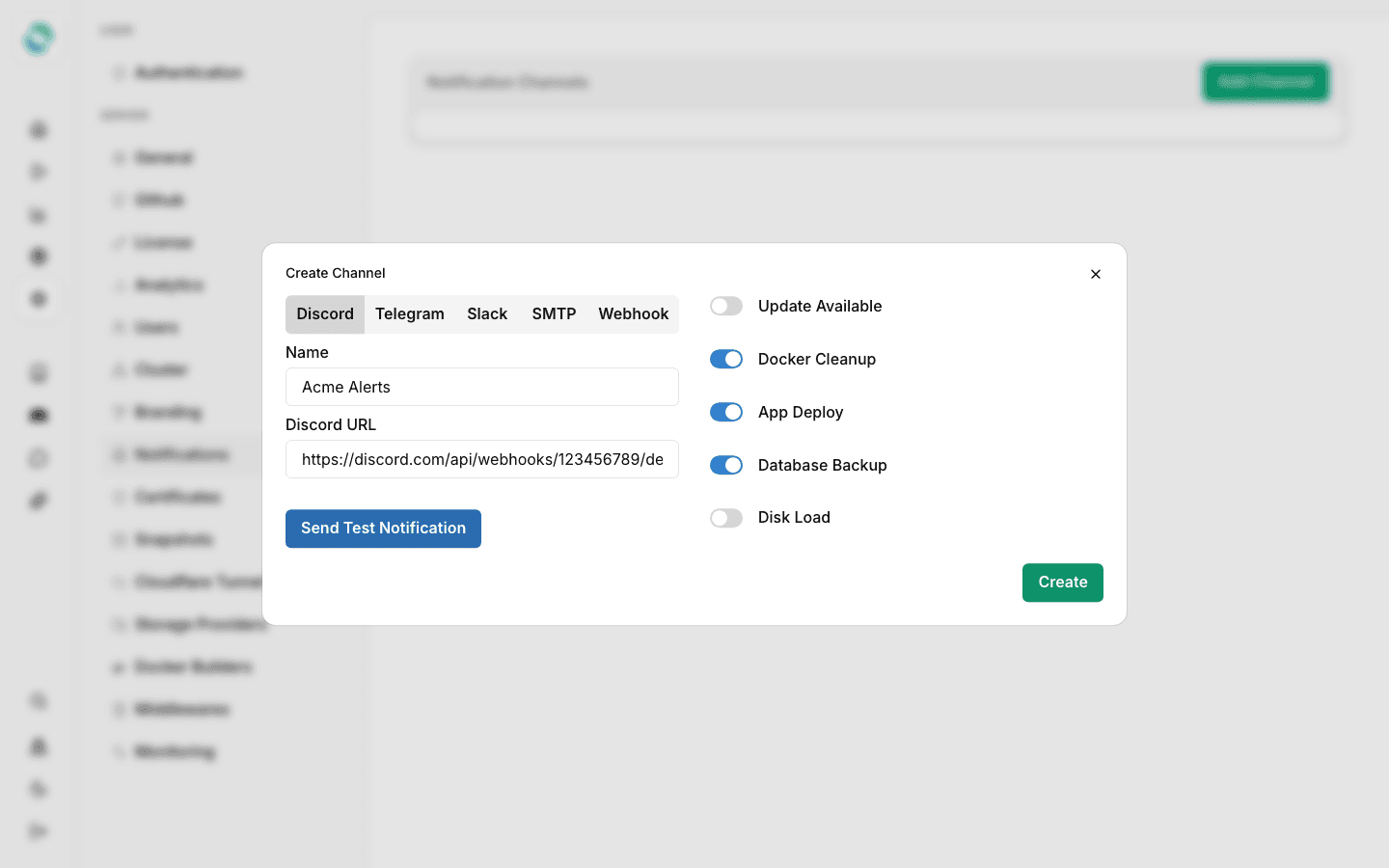
To change or remove a channel later, open its actions menu in the Notification Channels list and select Edit or Remove.
Events
| Event | Sent when |
|---|---|
| Update Available | Easypanel detects that a new version is available. |
| Docker Cleanup | The scheduled Daily Docker Cleanup finishes. Turn it on in Settings → Server → General; it runs every day at 02:00. |
| App Deploy | An App or Compose service deploys successfully. |
| Database Backup | A scheduled or manual database backup succeeds. |
| Disk Load | A scheduled check finds disk usage above the set percentage. |
Notifications report successes only. A failed deployment or backup does not send a notification, so check the service's deployment history or backup logs when an expected notification does not arrive.
Disk Load
When you turn on Disk Load, two more settings appear:
- Min Usage Percentage: the threshold. A notification is sent when usage of
the disk Easypanel runs on is above this value. The default is
80. - Schedule: how often to check, as a preset or a cron expression. The
default is every day at
02:00, in the server's time.
Every check that finds usage above the threshold sends a notification, so a schedule such as Every minute sends one every minute until you free up space.
Message format
Every notification has a title and a message. The title starts with your panel domain in brackets, so you can tell servers apart when several report to the same channel:
[panel.example.com] App my-project/api successfully deployed
Easypanel successfully deployed your app.
The panel domain is your custom panel domain when one is set, otherwise the
default easypanel.host domain. Docker Cleanup and Disk Load notifications
have a title and no message.
Discord
- In Discord, open the channel's settings, then Integrations → Webhooks.
- Select New Webhook, choose a name and channel, and select Copy Webhook URL.
- In Easypanel, choose Discord and paste the URL into Discord URL.
Slack
- Go to api.slack.com/apps and create an app for your workspace.
- Under Features, open Incoming Webhooks and turn them on.
- Select Add New Webhook to Workspace, pick a channel, and copy the webhook URL.
- In Easypanel, choose Slack and paste the URL into Slack URL.
Telegram
-
Open @BotFather, send
/newbot, and follow the prompts. BotFather replies with the bot's access token. -
Add the bot to the group that should receive notifications and send
/startin the group. For notifications in a direct chat, open a chat with the bot and send/startthere instead. -
Find the chat ID. Open the following URL in a browser, replacing
<token>with the bot's token, and look for"chat":{"id":...}in the response. Group chat IDs are negative numbers; copy the minus sign too.https://api.telegram.org/bot<token>/getUpdatesIf the response is empty, send
/startagain and reload. -
In Easypanel, choose Telegram and enter the Bot Access Token and Chat ID.
Easypanel sends email through an SMTP server you provide, such as your email provider or a transactional email service.
- Choose SMTP.
- Enter the server's Host and Port. Most providers use port
587. - Enter the Username and Password for the SMTP account.
- Optionally set Sender (From) to the address the emails should come from. Leave it empty to send from the username. The SMTP server must allow sending from that address; many providers require it to be a verified sender.
- Enter one or more recipients. Select Add Recipient for each extra address.
The email subject is the notification title, and the body is the message.
Emails show Easypanel as the sender name.
Webhook
Use a webhook to send notifications to your own service, an automation tool, or a chat platform without built-in support.
- Choose Webhook.
- Enter the Webhook URL that should receive the notifications.
- Optionally enter a Webhook secret.
Easypanel sends a POST request with a JSON body:
{
  "title": "[panel.example.com] App my-project/api successfully deployed",
  "message": "Easypanel successfully deployed your app.",
  "secret": "your-webhook-secret"
}
secret is the value you entered, sent as-is in the body. Check it on the
receiving side to reject requests that did not come from your panel, and serve
the endpoint over HTTPS so the secret is not sent in plain text.
Troubleshooting
If a notification does not arrive:
- Edit the channel and select Send Test Notification. An error message usually points to the problem, such as a wrong URL, token, or SMTP credentials.
- Confirm that the event is turned on for that channel and that the action actually succeeded. Failed deployments and backups do not send notifications.
- Confirm that the server can reach the destination. Firewalls that block outgoing traffic, or SMTP ports blocked by the hosting provider, stop delivery.
- For email, check the recipient's spam folder and whether the provider accepts the Sender (From) address.
Easypanel does not retry failed notifications. A failed delivery is written to the panel's logs and does not affect deployments, backups, or the panel itself.